)
)
)
From Best Practice to Standard Practice: How Commercial P&C Underwriters and Actuaries Are Applying AI from Submission to Decision
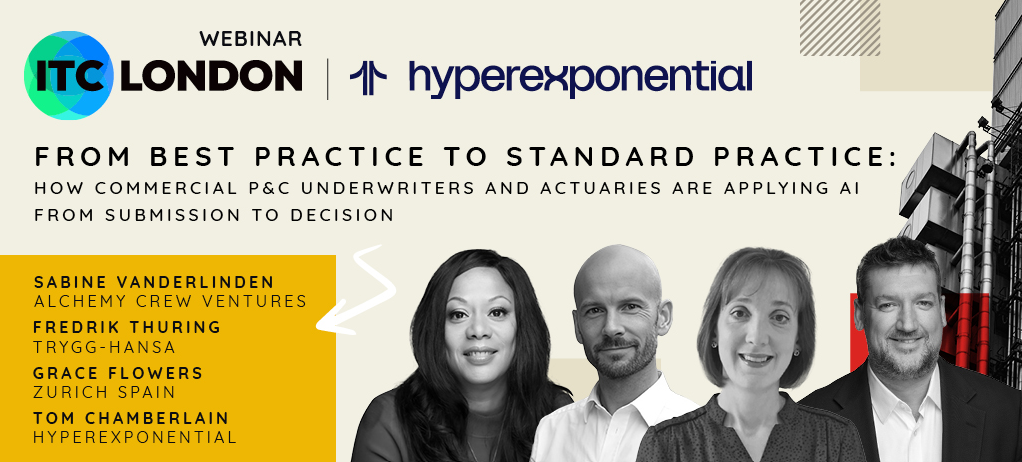
The commercial insurance sector is entering a decisive new phase in its AI journey. After years of experimentation and isolated pilots, insurers are now increasingly focused on embedding AI into the core of underwriting, pricing, portfolio steering and customer value creation. A recent webinar by ITC in partnership with Hyperexponential featuring Grace Flowers, Chief Underwriting Officer, Zurich Spain, Fredrik Thuring, Head of Operational Analytics, Trygg-Hansa, Sabine VanderLinden, Co-Founder, CEO & Venture-Client Partner, Alchemy Crew Ventures, and moderated by Tom Chamberlain, Chief Customer Officer, Hyperexponential illuminated how far the market has come and how much further it is poised to go.
From Incremental Gains to Underwriting Transformation
Early adoption of AI in insurance revolved largely around efficiency and automation. But panellists agreed that the real inflection point lies in augmenting decision-making, not just reducing workload.
Tom Chamberlain emphasised that the biggest opportunity sits squarely in improving loss ratios, not expense ratios:
“You need that large language model capability… but ultimately what we’re trying to do is influence the loss ratio. That’s where the real leverage is.”
The emerging vision is an AI-supercharged underwriter. Chamberlain described an “underwriting assistant” that can interrogate all available data on a risk or portfolio, answer ad-hoc questions, and provide instant insights that today require long reporting cycles.
“Why is this premium higher than a similar risk I wrote the other day? Why are these locations showing higher hazard? You’ll be able to assess accumulation on the spot—no waiting a month for a report.”
Fredrik Thuring agreed, positioning underwriting as the natural home turf of generative AI:
“If underwriting is ultimately about information assessment, GenAI is the perfect fit… the sky’s the limit.”
This shift fundamentally redefines the role of the underwriter. In Grace Flowers’ view, underwriters will increasingly become strategic risk advisors, leveraging AI to rapidly process information while focusing their own expertise on judgement, negotiation, creativity and customer value.
Beyond Underwriting: Predict & Prevent, Dynamic Portfolios, and AI Teammates
Panellists also highlighted a wave of second-generation use cases that go beyond underwriting accuracy.
-
Predict & Prevent Risk Services
Thuring framed this as a major future opportunity:“Use our troves of claims and customer data… to spot patterns and tell customers what to change to avoid claims. That could transform what we’re offering; not just protection after a loss but preventing it.”
-
Dynamic Portfolio Steering
Real-time portfolio analytics – enabled by conversational interfaces – could eliminate entire layers of static reporting. -
AI ‘Teammates’ and Agentic Systems
VanderLinden described a future where AI evolves from copilots to teams of specialised agents:“Platforms will act as teammates—each expert seeing the data through their lens but from one single view of the truth. You can have 10 AI underwriting assistants, a catastrophe agent, an SoV analyser… all collaborating.”
She noted the emerging concept of agentic AI meshes—networks of AI workers that communicate, coordinate and solve problems together.
“We may even need HR for AI workers,” she added.
Data: Imperfect but Improving
While quality data remains critical, the panel rejected the notion that insurers must wait for perfection before scaling AI.
As Flowers cautioned:
“We mustn’t get obsessed with having perfect data. We’ve never had perfect data—and we still do pricing, underwriting and portfolio management.”
Instead, AI adoption should itself drive data improvement, through validation at the point of entry, automated cleaning and clearer identification of critical fields.
Thuring added that for many generative AI applications, internal data requirements can be surprisingly light:
“If you prompt a model properly—‘you’re an underwriter, here’s our risk appetite’—it already knows how to underwrite based on broader training data.”
Still, VanderLinden stressed the importance of trustworthy datasets, single sources of truth and “trust by design”—including explainability, governance and human oversight.
The Changing Skillset: From Data Gathering to Strategic Orchestration
Across the group, there was consensus that underwriting will become more strategic, more commercial and more creative.
Future underwriting talent must be:
- Data-literate but not data-dependent
- Strong decision-makers able to challenge and override AI
- Creative problem-solvers, not just evaluators
- Excellent communicators, capable of translating model insights into clear commercial action
- Comfortable orchestrating AI systems, not just performing tasks themselves
VanderLinden summarised the shift well:
“We will use more soft skills—strategic thinking, questioning, judgement—while AI handles the heavy information lifting.”
Why Some Insurers Scale AI—and Others Don’t
VanderLinden pointed to industry research showing that 88% of AI pilots fail to scale, but noted several traits common to the successful minority:
- Executive sponsorship and clear strategic intent
- Cultural readiness and internal openness to augmentation
- Designing for adoption, not experimentation
- Re-imagining processes, rather than automating legacy ones
- Clear metrics and KPIs from day one
- Reusable playbooks and innovation pathways
Thuring added a critical lesson:
“If you try to AI-ify an existing manual process, it often fails. Start from scratch with AI at the centre.”
A Sector on the Brink of Acceleration
The panel concluded with optimism. While insurers still face data challenges, legacy processes and cultural inertia, the capability and maturity of AI technology have advanced dramatically.
What’s emerging is not automation for its own sake, but a new operating model—one where underwriters, data scientists, and AI agents work side-by-side, elevating decision-making, accelerating insight and creating new value for customers.
Commercial insurance may soon look fundamentally different. But for carriers willing to rethink processes, invest in adoption and empower their people, the prize is clear: faster decisions, deeper insight, stronger portfolios and entirely new forms of risk prevention and customer service.